
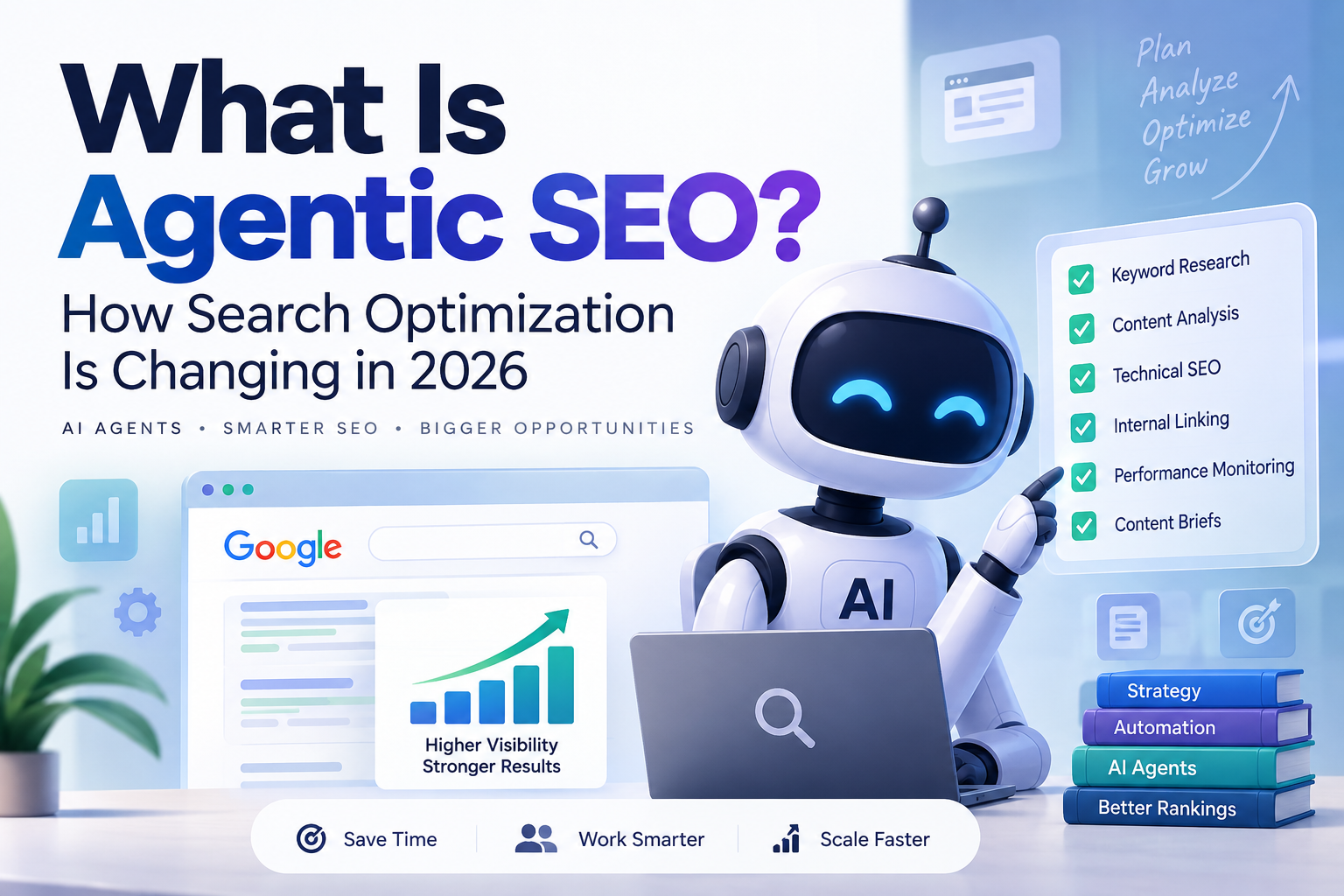
Agentic SEO is the use of AI agents to perform multi-step SEO tasks with less manual input. These agents can analyze data, choose actions, and complete approved SEO workflows more independently than basic automation. In 2026, it is becoming an important way to speed up research, monitoring, and optimization while keeping human oversight in place.
What Is Agentic SEO?
Agentic SEO is the use of AI agents to perform multi-step SEO tasks with limited human input. Instead of responding to one prompt at a time, an AI agent can receive a goal, collect data, analyze information, choose the next step, and complete approved SEO actions.
In simple terms, traditional AI helps with individual SEO tasks, while agentic SEO connects several tasks into one goal-driven workflow.
How Does Agentic SEO Work?
Agentic SEO usually works through a sequence of connected actions.
A typical workflow looks like this:
Goal → Data Collection → Analysis → Decision → Action → Review
First, a human defines an objective. The AI agent then gathers relevant information from approved sources such as Google Search Console, analytics platforms, SEO tools, website crawlers, or content databases.
The agent analyzes that information and decides what steps are needed to reach the objective.
Depending on its permissions, it may then:
- research keywords;
- analyze search results;
- identify declining pages;
- find technical SEO problems;
- recommend internal links;
- prepare content briefs;
- suggest title or meta-description improvements;
- analyze competitor pages;
- or create SEO reports.
More advanced agents may also be connected to content management systems or other business tools. However, important website changes should normally have human approval before publication.
Agentic SEO vs Traditional SEO Automation
Agentic SEO and SEO automation are related, but they are not exactly the same.
Traditional automation usually follows predefined rules.
For example:
“Run a website crawl every Monday and email the report.”
The workflow has already been decided by a human.
Agentic SEO can be more flexible. Instead of only following one fixed sequence, an AI agent can analyze the situation and determine which permitted step should happen next.
| SEO Automation | Agentic SEO |
|---|---|
| Follows predefined rules | Works toward a defined goal |
| Performs predictable tasks | Can choose between different actions |
| Usually uses fixed workflows | Can adapt its workflow |
| Limited reasoning | Uses AI reasoning and analysis |
| Human defines most steps | Human defines goals and limits |
This does not mean agents should replace traditional automation. Simple tasks such as checking broken links or running scheduled reports may still be better handled with conventional automation.
What SEO Tasks Can AI Agents Perform?
AI agents can assist with many common SEO activities.
Keyword Research
Agents can collect related search terms, organize them by topic, analyze search intent, and identify possible content opportunities.
Content Analysis
An agent can review existing pages, compare them with current search results, identify missing information, and suggest updates.
Technical SEO
Agents may help identify crawl errors, broken links, indexing problems, duplicate content, or other technical issues.
Internal Linking
An agent can analyze website pages and suggest relevant internal links between related articles.
SEO Monitoring
Agents can regularly check rankings, traffic, impressions, clicks, and other SEO data to identify unusual changes.
Content Briefs
An agent could analyze competing results, related questions, search intent, and existing website content before preparing a detailed content brief.
Agentic SEO vs AI SEO
AI SEO is a broader term.
It includes almost any use of artificial intelligence in search optimization, such as:
- generating article ideas;
- improving titles;
- summarizing keyword data;
- creating content outlines;
- drafting schema;
- or analyzing pages.
Agentic SEO is more specific because the system can work through several connected steps toward an objective.
A simple way to understand the difference is:
AI SEO = using AI for SEO tasks.
Agentic SEO = using AI agents to manage multi-step SEO workflows.
Is Agentic SEO the Same as GEO?
No.
Agentic SEO should not be confused with Generative Engine Optimization (GEO).
GEO generally focuses on improving visibility within AI-generated search experiences.
Agentic SEO mainly describes the use of AI agents to perform SEO work.
There is also an emerging concept of making websites easier for autonomous AI agents to understand and interact with. This is better described separately as creating an agent-friendly website.
Is Agentic SEO an Official Google Ranking Factor?
No.
Google has not announced “agentic SEO” as a ranking factor.
Using an AI agent does not automatically improve search rankings. Google evaluates the resulting website and content rather than rewarding the method used to optimize it.
Businesses should therefore avoid unsupported claims that Google rewards agentic SEO or that AI agents automatically increase rankings.
What Are the Benefits of Agentic SEO?
The main advantages are related to efficiency rather than guaranteed rankings.
Faster research: Agents can gather information from multiple sources with less manual work.
Continuous monitoring: They can regularly check SEO performance and identify problems.
Reduced repetitive work: Data collection, reporting, and opportunity discovery can be automated.
Better workflow coordination: Agents can connect research, analysis, recommendations, and measurement.
Scalability: Larger websites can analyze more pages and data than a person could manually review.
These benefits allow SEO professionals to spend more time on strategy and important decisions.
What Are the Risks of Agentic SEO?
Agentic SEO also introduces several risks.
Incorrect Decisions
AI systems can misinterpret data or reach the wrong conclusion.
Hallucinated Information
Agents may generate inaccurate information when reliable evidence is unavailable.
Excessive Automation
Automatically changing or publishing hundreds of pages without proper review can harm website quality.
Security Risks
Agents connected to analytics, a CMS, or technical systems need carefully controlled permissions.
Low-Quality Content
Using agents mainly to mass-produce search-focused pages can result in repetitive or low-value content.
For these reasons, businesses should introduce agentic SEO gradually rather than immediately giving an AI system full control.
Does Agentic SEO Still Need Humans?
Yes.
Human oversight remains important for:
- strategy;
- editorial judgment;
- fact-checking;
- brand decisions;
- technical changes;
- quality control;
- and final accountability.
A practical approach is to give AI more independence for low-risk tasks while requiring human approval for important changes.
For example, an agent may identify declining articles automatically, while an editor reviews and approves the recommended updates.
Will Agentic SEO Replace Traditional SEO?
Agentic SEO is more likely to change how SEO work is performed than replace SEO itself.
Important fundamentals still matter, including:
- search intent;
- useful content;
- crawlability;
- website structure;
- internal linking;
- technical SEO;
- and accurate information.
AI agents can make these processes faster, but they do not remove the need for sound SEO practices.
SEO professionals may increasingly spend less time on repetitive work and more time defining goals, reviewing AI recommendations, and making strategic decisions.
How Can You Start Using Agentic SEO?
Start with a small, low-risk workflow.
For example:
“Find articles that have lost organic traffic and prepare recommendations for improving them. Do not publish any changes.”
Before giving an agent more control, define:
- what information it can access;
- what tools it can use;
- which actions it can perform;
- which actions require approval;
- and how results will be measured.
The goal should be to automate useful repetitive work, not every SEO decision.
Frequently Asked Questions
Is agentic SEO the same as AI SEO?
No. AI SEO covers any use of artificial intelligence in SEO, while agentic SEO specifically involves AI agents handling multi-step workflows.
Can agentic SEO improve rankings?
It can help teams identify and complete useful SEO improvements more efficiently, but using an AI agent itself does not guarantee higher rankings.
Does Google recognize agentic SEO?
Google discusses AI agents and agentic experiences, but “agentic SEO” is mainly an industry term rather than an official Google ranking concept.
Can AI agents automatically publish articles?
Yes, if they are connected to a CMS with publishing permission. However, human editorial review is safer for important content.
Will AI agents replace SEO professionals?
They are more likely to automate repetitive SEO work while professionals continue handling strategy, judgment, quality control, and important decisions.
Conclusion
Agentic SEO uses AI agents to manage connected SEO tasks such as research, analysis, monitoring, and recommendations.
It can make SEO workflows faster, but it is not a Google ranking factor and does not replace SEO fundamentals. In 2026, the most effective approach is to use AI agents for repetitive work while keeping humans responsible for strategy, quality, and important website decisions.