
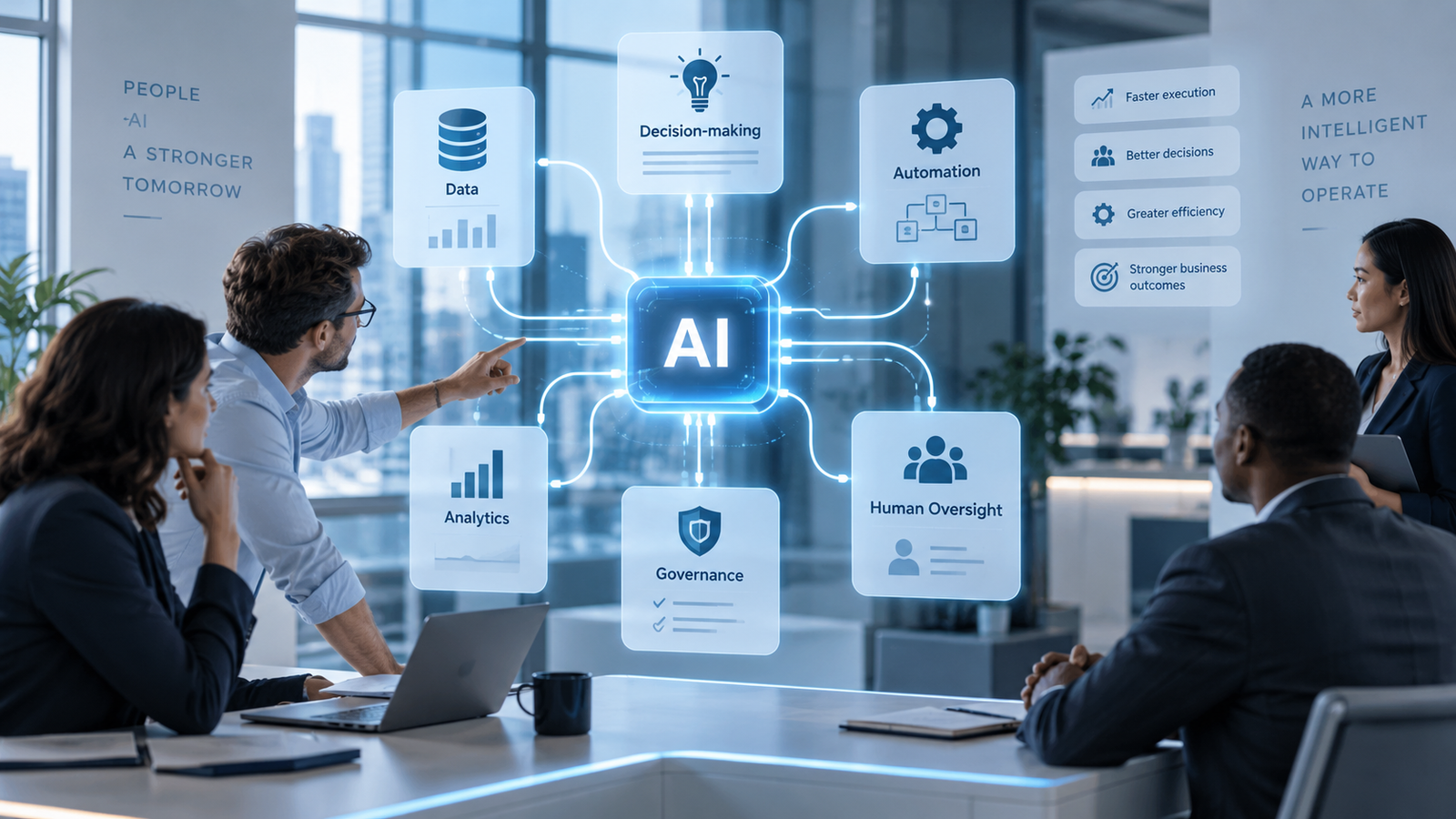
An AI-first operating model is a business structure where AI is built into workflows, decision-making, data use, and everyday operations from the start. Instead of simply adding AI tools to existing processes, companies redesign how people, technology, and AI work together to achieve better outcomes.
What Is an AI-First Operating Model?
An AI-first operating model is a way of designing a business so that artificial intelligence is built into how work is structured, decisions are made, data is used, and outcomes are delivered not simply added as another productivity tool. In an AI-first organization, leaders ask how a workflow should be designed if AI capabilities, automation, and human judgment were available from the start.
Giving employees ChatGPT, copilots, or automated tools may make an existing process faster, but it does not automatically change the operating model. Current 2026 research increasingly describes AI-first transformation as an organizational redesign problem rather than a software-deployment problem.
What Does “AI-First” Mean in Business?
“AI-first” means treating AI as a foundational capability in the business rather than a supporting layer. The World Economic Forum describes AI-first organizations as being designed or redesigned around AI-native business and operating models, with intelligence embedded across workflows and decisions.
This does not mean every task should be automated or every decision delegated to a model. It means each important workflow is reconsidered around the best division of work between people, software, data, automation, and AI systems.
A useful question is: if the organization were being designed today, with modern AI available from day one, would it create the same roles, approval chains, handoffs, and processes? Arthur D. Little uses essentially this design-from-scratch perspective when describing the move toward AI-first organizations.
AI-First vs. AI-Enabled: What Is the Difference?
The clearest difference is whether AI is added to an existing way of working or changes the way work itself is organized.
| Area | AI-enabled organization | AI-first operating model |
|---|---|---|
| Workflows | Existing processes gain AI tools | Processes are redesigned around outcomes and AI capabilities |
| Human role | People remain the default executor | People focus more on judgment, exceptions, relationships, and accountability |
| AI role | Assistant or isolated automation | Embedded participant that can recommend, execute, monitor, or coordinate within limits |
| Data | Often fragmented by application or team | Connected, governed data supports AI-driven work |
| Governance | Added after tools are selected | Built into workflow design, access, monitoring, and escalation |
| Improvement | Periodic optimization | Continuous feedback, evaluation, and learning |
This is also why an AI-first model is not the same as generic automation. Traditional automation usually follows predefined rules. AI can interpret unstructured information, generate outputs, make recommendations, and—in agentic systems—take multi-step actions. Those capabilities require new controls and clear human-review rules.
What Are the Key Components of an AI-First Operating Model?
Current research uses different frameworks, but several components recur across WEF, Deloitte, IBM, Microsoft, and other enterprise research.
Outcome-Driven Workflow Design
Instead of asking, “Where can we insert AI into this process?” teams start with the desired outcome and redesign the workflow around it. The World Economic Forum notes that AI-first organizations move away from merely optimizing individual steps toward end-to-end outcomes.
For example, a customer-service workflow could classify an issue, retrieve account context, prepare or execute an approved resolution, and escalate only unusual or sensitive cases rather than passing every ticket through the same manual chain.
Human-AI Collaboration and Clear Decision Rights
AI-first does not mean human-free. It requires explicit boundaries.
AI may handle pattern recognition, drafting, monitoring, routine execution, or coordination. Employees and domain experts may retain responsibility for ambiguous cases, high-impact judgments, relationships, policy decisions, and final accountability. Managers need to decide what agents can do independently, what requires approval, and when escalation is mandatory.
Deloitte’s 2026 AI-first blueprint similarly describes human-agent collaboration as a core feature, with AI taking more execution and pattern-recognition work while humans contribute judgment and other human capabilities.
Common modes include: AI recommends and a human decides; AI executes and a human monitors; or AI handles routine cases while people manage exceptions.
AI-Ready Data and Technology
AI-driven workflows depend on reliable context. IBM’s 2026 operating-model framing emphasizes coordinated agents, connected real-time data, automation, and controlled infrastructure.
An organization cannot operate AI-first if important data is inaccessible, inconsistent, poorly governed, or disconnected from the systems where work happens.
The technology layer also needs monitoring, identity and access controls, integration, evaluation, and agent or model management.
Governance, Security, and Accountability
Governance should be designed into the operating model, not added at the end. Organizations need rules for data access, privacy, security, model use, agent permissions, human review, monitoring, incident handling, and accountability.
As organizations move from a few AI tools toward larger numbers of agents, IBM notes that keeping those agents governed and auditable becomes an operational challenge in itself.
A useful design question is not only “Is this AI allowed?” but “What can it do, with which data, under whose authority, and what happens when confidence is low or an outcome is risky?”
Continuous Learning and Feedback
AI-first systems are often designed as learning loops. User feedback, overrides, exceptions, quality checks, and operating results can inform improvements. The World Economic Forum highlights adaptive loops, context documentation, clear data definitions, and real-time evaluation among characteristics emerging in AI-first workflows.
That does not mean systems should change themselves without control. It means the operating model deliberately captures feedback to improve processes, models, policies, or human training.
What Does an AI-First Workflow Look Like in Practice?
Consider a finance team handling supplier invoices.
In a conventional process, employees may download invoices, validate fields, check purchase orders, identify anomalies, request approvals, and enter data into finance systems. Adding OCR would automate one step, but the workflow would remain mostly unchanged.
In an AI-first redesign, an AI system could ingest the invoice, match it with purchase orders and contracts, flag unusual terms, route low-risk items through predefined controls, prepare explanations for exceptions, and send uncertain or high-value cases to a finance professional.
Human reviewers would remain accountable for policy, fraud concerns, exceptions, and material decisions.
The key change is not the presence of AI. It is the redesign of the end-to-end flow, responsibilities, controls, and handoffs.
Why Are Companies Moving Toward AI-First Operating Models?
Isolated AI tools can create local efficiency without changing enterprise performance.
Microsoft’s 2026 Work Trend Index found that organizational factors—including culture, management support, and talent practices—were more strongly associated with reported AI impact than individual behavior alone. Microsoft argues that closing this gap requires redesigning the operating model across employees, leaders, and the organization.
Roland Berger’s 2026 study of 472 executives and senior leaders also found a gap between expectations and action: 62% expected major or radical operating-model changes from AI transformation, while 38% said their organizations had begun acting on those changes.
Potential benefits include faster cycle times, more scalable service, better use of organizational knowledge, and more responsive decision-making. These benefits are not automatic and should not be treated as guaranteed ROI.
What Are the Main Risks and Challenges?
Common challenges include poor data quality, hallucinated or unreliable outputs, weak security, privacy exposure, unclear accountability, excessive agent permissions, legacy-system constraints, skills gaps, and resistance to changing roles.
Another risk is automating a bad process instead of rethinking it. A faster version of a fragmented workflow may still be fragmented.
Organizations should also avoid delegating high-impact decisions merely because an AI system can technically perform them. Human oversight, escalation, monitoring, and defined accountability become more important as AI receives greater autonomy.
How Can an Organization Move Toward an AI-First Model?
Most organizations do not need to redesign everything at once. Start with a small number of valuable workflows.
First, define the business outcome rather than the AI tool. Map the current process and identify decisions, bottlenecks, handoffs, data dependencies, and risk points.
Then decide what should be handled by people, AI, or conventional automation. Build governance, access controls, evaluation, and escalation into the workflow before scaling it.
After deployment, measure quality, reliability, adoption, risk, cycle time, and business outcomes. Expand only when the redesigned workflow is demonstrably better than the old one.
Becoming AI-first is therefore less about buying more AI and more about changing how the organization coordinates work, intelligence, people, and accountability.
FAQs
Does AI-first mean replacing employees?
No. Current frameworks generally emphasize human-AI collaboration. AI may take on more execution, but people remain important for judgment, oversight, relationships, exceptions, and accountability. Microsoft’s 2026 research similarly places human judgment at the center of consequential work even as agents handle more execution.
Is an AI-first operating model the same as digital transformation?
No. Digital transformation can modernize systems, channels, and processes without making AI central to how work is designed. AI-first is a more specific operating-model approach built around AI capabilities and human-AI collaboration.
What Is an Agentic Operating Model?
An agentic operating model is a related concept focused on AI agents that can plan or execute multi-step work. It requires clear permissions, orchestration, monitoring, escalation, and governance.
Can a Small Business Become AI-First?
Yes. A small company may redesign a few core workflows around AI without building the complex platform architecture required by a large enterprise.
Is Every Company Ready for an AI-First Operating Model?
No. Organizations with weak data, unclear ownership, poor security controls, or immature processes may need to strengthen those foundations first. AI-first design should follow business needs and risk tolerance rather than become a branding exercise.
Conclusion
An AI-first operating model is not a company with many AI tools. It is an organization that deliberately redesigns workflows, decision rights, technology, data, roles, and governance around the combined capabilities of AI and people.
The strongest 2026 thinking points to the same lesson: the shift becomes meaningful when AI changes how the business operates, not merely which software employees use.