
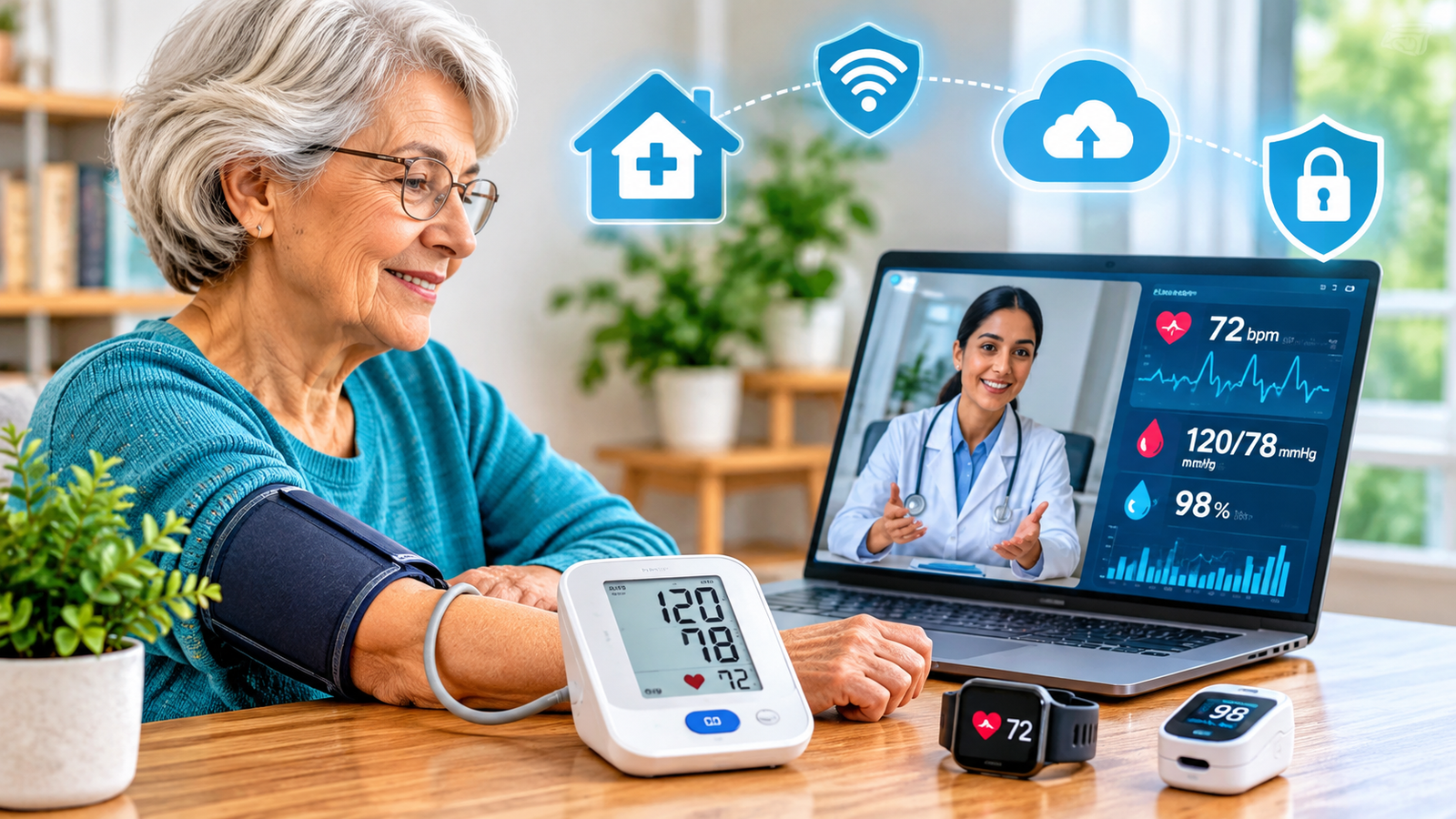
Healthcare is increasingly moving beyond hospitals and traditional clinic visits. Connected medical devices, wearable sensors, and digital health platforms now allow patients to share selected health measurements with healthcare professionals from home.
This approach, known as remote patient monitoring (RPM), is becoming an important part of digital healthcare. Remote Patient Monitoring Trends 2026 highlight developments in artificial intelligence (AI), connected medical devices, wearable technology, and healthcare data integration.
These technologies can provide additional information between appointments and support chronic disease management. However, their effectiveness depends on accurate devices, reliable systems, patient participation, and appropriate clinical oversight.
What Is Remote Patient Monitoring?
Remote patient monitoring is a healthcare approach that allows patients to collect health measurements outside traditional clinical settings using connected medical devices. The information is transmitted electronically to healthcare professionals for review.
For example, a patient with hypertension may use a connected blood pressure monitor at home. Their readings can be shared with a healthcare team, which can review changes and decide whether further assessment or treatment adjustments are necessary.
RPM is different from telehealth. Telehealth primarily delivers healthcare through video calls, phone consultations, and digital communication. RPM focuses on collecting and reviewing patient health measurements remotely. Both approaches can complement each other.
How Does Remote Patient Monitoring Technology Work?
A typical RPM program involves six basic steps:
- Patient enrollment: A healthcare professional determines whether remote monitoring is appropriate and selects suitable equipment.
- Measurement collection: Patients use devices to record information such as blood pressure, blood glucose, heart rate, oxygen saturation, or body weight.
- Data transmission: Measurements are transferred through Bluetooth, Wi-Fi, cellular connectivity, or a connected application.
- Data analysis: The monitoring platform organizes readings and may identify measurements outside predefined thresholds.
- Professional review: Healthcare professionals examine relevant information according to established clinical protocols.
- Follow-up: When necessary, the healthcare team contacts the patient, arranges further assessment, or adjusts the care plan.
An automated alert is not a medical diagnosis. Clinical professionals must interpret measurements in the context of each patient’s condition.
Major Remote Patient Monitoring Trends 2026
Several developments are shaping remote healthcare monitoring in 2026.
1. AI in Remote Patient Monitoring
Artificial intelligence is helping monitoring platforms process large amounts of health information and identify patterns that may require attention.
Potential applications include:
- Identifying unusual changes in blood pressure or heart rate.
- Recognizing patterns in glucose measurements.
- Generating alerts when readings cross predefined thresholds.
- Summarizing monitoring data for clinical review.
- Helping healthcare teams prioritize patients who may need follow-up.
However, AI systems can produce false alerts or overlook important changes. Research findings also show that many machine learning studies in remote monitoring still have methodological limitations. Clinical validation and professional oversight remain essential.
2. Connected Medical Devices and Smart Sensors
Connected medical devices allow patients to transmit measurements directly to digital healthcare platforms.
Common examples include blood pressure monitors, glucose meters, pulse oximeters, and digital weighing scales. Smart sensors and wearable devices are also being developed to collect additional physiological and activity information.
These technologies can reduce manual data entry, but device accuracy and clinical suitability must be considered before implementation.
3. Wearable Health Monitoring
Smartwatches, fitness bands, and specialized wearable sensors can collect information such as:
- Heart rate.
- Physical activity.
- Sleep patterns.
- Skin temperature.
- Blood oxygen estimates.
- ECG-related information on selected devices.
Wearables may support certain monitoring programs, but consumer fitness trackers should not automatically be treated as medical devices. Their accuracy, intended use, and regulatory status vary.
4. Home-Based Healthcare Monitoring
Home patient monitoring devices allow people with selected health conditions to collect measurements without visiting a clinic for every routine check.
For example, patients with hypertension may monitor blood pressure at home, while some people with heart failure may be asked to track body weight and report relevant symptoms.
These programs can provide useful information between appointments, provided patients receive proper instructions, and healthcare teams have a clear process for reviewing results.
5. Electronic Health Record Integration
Remote monitoring platforms can become more useful when they exchange relevant information with electronic health records (EHRs).
Integration may allow healthcare professionals to review monitoring measurements alongside medical history, medications, laboratory results, and previous appointments.
However, different software systems may use incompatible data formats and communication standards. Interoperability remains an important technical challenge.
6. More Advanced Healthcare Data Analytics
Healthcare organizations are increasingly interested in examining measurement patterns over time rather than relying on individual readings.
For example, reviewing several weeks of blood pressure measurements may provide more useful information than considering a single reading without context.
Data analytics can help organize these measurements, display changes, and support clinical review. The quality of the results still depends on accurate devices and appropriate interpretation.
7. Greater Focus on Data Security
RPM platforms handle sensitive health information that moves between devices, applications, cloud services, and healthcare organizations.
As adoption increases, providers need appropriate encryption, secure authentication, access controls, software updates, and data protection policies.
Common Remote Patient Monitoring Devices
The effectiveness of an RPM program partly depends on choosing equipment that meets the patient’s clinical needs.
| Device | Main purpose |
|---|---|
| Connected blood pressure monitor | Measures systolic and diastolic blood pressure |
| Blood glucose meter | Measures blood glucose levels |
| Continuous glucose monitor | Tracks glucose patterns throughout the day |
| Digital weighing scale | Records body weight |
| Pulse oximeter | Estimates blood oxygen saturation |
| Wearable heart rate monitor | Tracks heart rate and selected cardiovascular indicators |
Device selection should consider measurement accuracy, intended use, regulatory status, and patient requirements.
A connected device is not necessarily an approved medical device. Healthcare organizations should verify its suitability before including it in a clinical program.
Remote Patient Monitoring Benefits
Remote patient monitoring benefits depend on the patient’s condition and the quality of the monitoring program. When appropriately implemented, RPM may offer several advantages.
1. Convenient health measurements: Patients can collect selected readings at home instead of visiting a clinic for every routine measurement.
2. Additional information between appointments: Regular measurements can help healthcare professionals understand changes over time.
3. Support for chronic disease management: RPM can assist selected programs for conditions such as hypertension, diabetes, and heart failure.
4. Improved access to selected services: Remote monitoring may help people who live far from healthcare facilities or experience transportation difficulties.
5. More informed follow-up: Recorded measurements can provide healthcare professionals with additional information when deciding whether further assessment is needed.
6. Better care coordination: When information is shared appropriately, nurses and physicians can review measurements according to established clinical responsibilities.
What Does Research Say About RPM Effectiveness?
A 2025 systematic review and meta-analysis examined 40 randomized controlled trials involving remote monitoring for noncommunicable diseases. It found that RPM may slightly reduce the proportion of patients experiencing hospitalization compared with usual care, although the certainty of evidence was low.
This suggests that RPM can be useful in selected settings, but its benefits should not be assumed for every patient or healthcare program.
AI in Remote Healthcare Monitoring: Opportunities and Limitations
AI can support remote monitoring by identifying patterns, organizing measurements, generating alerts, and helping healthcare teams review incoming information.
However, important limitations remain:
- False alerts: Systems may identify problems that do not require intervention.
- Missed abnormalities: Algorithms may fail to recognize meaningful changes.
- Algorithmic bias: Models may perform differently across patient populations.
- Data quality: Inaccurate measurements can affect analytical results.
- Limited validation: Technical performance does not automatically prove better patient outcomes.
- Privacy risks: AI systems may process sensitive personal health information.
AI should support healthcare professionals, not replace qualified medical judgment.
Remote Patient Monitoring Challenges
Despite its potential, RPM involves several practical and clinical challenges.
1. Data Privacy and Security
Monitoring platforms collect sensitive patient information. Healthcare organizations need encryption, secure authentication, access controls, regular security updates, and appropriate consent procedures.
2. Internet Connectivity
Unreliable internet or cellular connections can interrupt data transmission. Bluetooth failures, synchronization errors, and platform downtime can also affect monitoring.
3. Device Accuracy
Incorrect readings may lead to inappropriate decisions. Device quality, calibration, proper use, and patient instructions are therefore important.
4. Patient Adoption and Digital Literacy
Some patients may struggle with smartphones, applications, or connected devices. Accessible instructions, technical support, and simple interfaces can improve participation.
5. Cost and Reimbursement
RPM programs involve equipment, software, staff training, technical support, security, and ongoing clinical monitoring. Reimbursement rules also vary by country and healthcare program.
6. Alert Fatigue and Clinical Workload
Too many notifications can make it harder for healthcare professionals to identify important changes. Clear alert thresholds, escalation procedures, and staff responsibilities are necessary.
7. Integration Problems
Different devices and software platforms may not exchange information smoothly. Healthcare organizations should consider interoperability when selecting RPM solutions.
Regulatory and Reimbursement Considerations in 2026
RPM requirements depend on the country, device type, intended use, and healthcare payment system.
In the United States, the Food and Drug Administration (FDA) regulates medical devices according to applicable requirements. Consumer wellness products do not automatically receive the same regulatory treatment as medical devices intended for clinical purposes.
The Centers for Medicare & Medicaid Services (CMS) also provides reimbursement pathways for qualifying remote physiologic monitoring services. Coverage depends on applicable requirements, including medical necessity, patient consent, qualifying devices, and service documentation.
Other countries have their own regulatory frameworks. These include the European Union’s Medical Device Regulation, the United Kingdom’s medical device framework, and Pakistan’s medical device regulations administered by the Drug Regulatory Authority of Pakistan (DRAP).
Healthcare organizations should verify current local requirements before implementing or billing an RPM service.
The Future of Remote Healthcare Monitoring
The future of remote healthcare monitoring will likely involve closer integration between medical devices, digital platforms, and healthcare professionals.
Important areas of development include:
- More personalized monitoring plans based on individual health needs.
- Improved information sharing between healthcare systems.
- More sophisticated wearable sensors.
- Greater use of AI-assisted data analysis.
- Simpler devices and applications with better accessibility.
- Stronger attention to cybersecurity and patient data protection.
These developments are potential directions, not guaranteed outcomes. Their adoption will depend on clinical evidence, affordability, infrastructure, regulation, and patient acceptance.
How to Choose the Right Remote Patient Monitoring Solution
Healthcare organizations should evaluate more than device prices and software features before selecting an RPM platform.
Important considerations include:
| Evaluation area | What to check |
|---|---|
| Clinical suitability | Does it measure the required health parameters? |
| Device accuracy | Is measurement reliability supported by evidence? |
| Regulatory status | Does it meet applicable requirements? |
| Data security | Are encryption and access controls implemented? |
| Interoperability | Can it connect with existing healthcare systems? |
| Patient experience | Is the equipment easy to use? |
| Technical support | Is help available when problems occur? |
| Total cost | Are staffing, training, software, and maintenance included? |
A successful solution should support the complete process, from patient enrollment and measurement collection to professional review and follow-up.
Frequently Asked Questions
1. What are the major remote patient monitoring trends in 2026?
Major trends include AI-assisted analysis, connected medical devices, wearable sensors, home-based monitoring, EHR integration, and improved healthcare data analytics.
2. What devices are used for remote patient monitoring?
Common devices include blood pressure monitors, glucose meters, continuous glucose monitors, pulse oximeters, digital weighing scales, and wearable heart rate monitors.
3. How does AI improve remote patient monitoring?
AI can help identify patterns, organize measurements, generate alerts, and support healthcare professionals in reviewing patient information. Its results require clinical oversight.
4. What are the main benefits of remote patient monitoring?
Potential benefits include convenient home measurements, additional information between appointments, support for chronic disease management, and improved access to selected healthcare services.
5. Is remote patient monitoring suitable for chronic diseases?
It can support selected conditions, including hypertension, diabetes, heart failure, and certain respiratory conditions. Suitability depends on individual medical needs.
6. Is remote patient monitoring secure?
It can be secure when appropriate safeguards are used, including encryption, authentication, access controls, software updates, and patient consent procedures.
7. Does remote patient monitoring replace doctor visits?
No. RPM complements traditional healthcare. Patients may still need physical examinations, laboratory tests, diagnostic procedures, and urgent medical attention.
8. What is the difference between RPM and wearable health tracking?
RPM is a clinical approach in which measurements are collected and reviewed as part of a healthcare program. Wearable health tracking generally focuses on personal wellness information. Some wearables can be used in clinical programs, but not all are suitable medical devices.
Conclusion
Remote patient monitoring is becoming an important part of digital healthcare in 2026. Connected medical devices, wearable sensors, AI-assisted analytics, and integrated platforms offer new ways to collect and review health information outside traditional clinical settings.
However, technology alone does not guarantee better outcomes. Device accuracy, patient participation, cybersecurity, interoperability, reimbursement, and clinical oversight all influence the success of an RPM program.
Healthcare organizations should focus on solutions that address genuine patient needs and support evidence-based medical practice.